

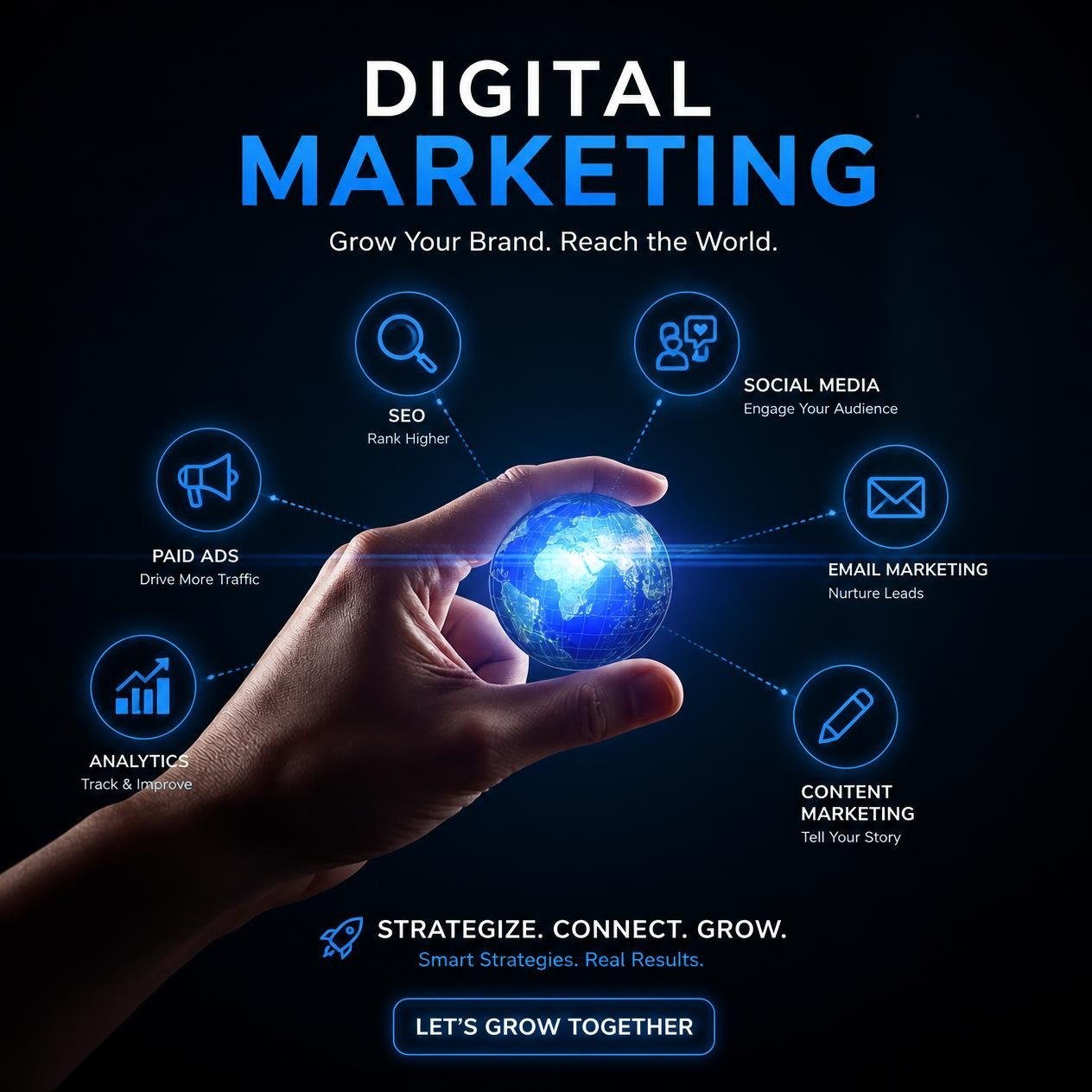
Digital Marketing (sometimes referred to as online marketing) is the process of promoting a brand or business, product using the internet and digital platforms. It helps businesses reach potential customers, build their brand, and increase sales or leads. It uses various strategies and tools to reach and engage targeted audiences.
What is Digital Marketing Strategies
Digital marketing has become an important part of how businesses reach people online. In 2026, customers spend a lot of time on search engines, social media, websites, and other digital platforms. Because of this, businesses need simple and effective digital marketing strategies to connect with the right audience.
Important Digital Marketing Strategies in 2026
Digital marketing is one of the most important ways for businesses to reach customers today. In 2026, digital marketing is becoming smarter, more personal, and more focused on providing useful content .
Some important digital marketing strategies businesses should focus on :
1. Search Engine Optimization (SEO)
SEO helps a website appear higher on search engines like Google. When people search for a product or service, good SEO can help your website get noticed. Search engine optimization is a digital strategy in which an organization optimizes webpages to rank as highly as possible in a search engine results page (SERP). The goal of an SEO strategy is to increase the quantity and quality of organic (unpaid) traffic to a website from search engines. This involves researching keywords specific to a search term and relevant to consumers, and then using techniques involving headings, titles, backlinks and metadata to help the content rank highly.
2. Search Engine Marketing (SEM)
Search engine marketing is similar to SEO in that it aims to increase the number of internet users who come across a piece of content when using a search engine. However, unlike SEO it is a form of paid advertising. Google Ads, which allows organizations to buy search results based on keywords and displays them at the top of a page in a designated advertising module, is a prominent example of SEM.
3. Social Media Marketing (SMM)
Social media platforms such as Instagram, Facebook, YouTube, and LinkedIn are important for connecting with customers.
Social media marketing campaigns do more than advertise goods and services. With an effective social media strategy, a brand can remain in ongoing conversations with its followers. It can also stay on top of trends in real-time and analyze performance metrics to build trust and continuously optimize its customer-facing practices.
4. Content Marketing
Content marketing means creating useful content for your audience. This can include blogs, videos, guides, social media posts, and infographics.
With a content marketing strategy, an organization creates relevant content distinct from an advertisement. Such as a white paper, podcast, infographic or blog—to attract a specific audience, encourage engagement and build trust. With content marketing, a company can promote brand awareness, establish thought leaders and industry experts from its employees and remain top-of-mind when consumers are looking to buy.
5. Google Ads and Paid Advertising
Google Ads is a useful way to reach potential customers quickly. Businesses can show advertisements when people search for specific products or services.
A good Google Ads strategy includes choosing the right keywords, writing clear advertisements, and targeting the right audience. Businesses should also regularly check their results and improve their campaigns to avoid wasting money.
6. Mobile Marketing
When the term ‘mobile marketing’ was first in use, this referred to marketing conducted over a mobile device using simple text messaging. Since the advent of smartphones, mobile marketing refers to more than basic text messages.
Today, mobile marketing engages potential customers across myriad digital platforms. It includes sophisticated SMS and MMS communications, the use of apps and app push notifications, and mobile-only promos and commerce opportunities. While simpler than other forms of digital marketing, it is considered highly effective as a marketing channel that can reach consumers in a way they are accustomed to communicating every day.
7. Email Marketing
Though one of the most enduring forms of digital marketing, email marketing has significantly evolved since the first organizations sent messages to consumers advertising a set of goods or services. Today, email marketing, assisted by automation and generative AI, can create personalized content for individual customers based on their preferences and purchase histories.
Common types of email marketing campaigns include postpurchase follow-ups and reminders after a customer has abandoned an item in a shopping cart. Content marketing strategies might also be deployed over email, encouraging customers to sign up for an email newsletter or listen to the latest episode of a podcast.
8. Pay-per-click (PPC) advertising
PPC advertising is a form of digital marketing where advertisers pay a fee each time a consumer interacts with an ad. These ads can be video advertisements, ads displayed in a search engine, or embedded content on a social media platform. As this form of marketing is paid rather than organic, organizations typically closely track metrics such as the click-through-rate to help ensure that PPC advertising is meeting key performance indicators (KPIs).
9. Affiliate marketing
Affiliate marketing is a performance-based marketing strategy where organizations reward partners, or affiliates, for driving traffic or sales through their promotional efforts. Typically, an organization recruits an affiliate with an established platform to promote their business to a relevant audience. Using a unique code or URL, the organization can track how many conversions resulted from the partnership, paying the affiliate a rate based on how many items were sold.
Benefits of digital marketing
An effective digital marketing strategy can dramatically increase conversions, generate new leads, and facilitate enduring customer relationships. Some of the benefits of digital marketing include:
Cost-effectiveness
Digital marketing tends to provide a greater return on investment, largely due to its lower cost and precise targeting in comparison to traditional forms of marketing.
Targeted audience reach

Advanced targeting and audience analytics allows digital marketers to advertise to granular populations with specific demographics, interests and behaviors, helping ensure efforts reach exactly the most relevant audiences.
Global reach
Digital marketing allows small businesses or local companies to reach a global audience, expanding market potential.
Measurable metrics and data integration
Digital marketing tactics both use and generate vast amounts of data, which allows organizations to track campaign performance in detail and make informed decisions.
The Role of AI in Digital Marketing
Artificial Intelligence (AI) is playing a bigger role in digital marketing in 2026. Marketers can use AI tools to generate content ideas, understand customer behavior, analyze data, create advertisements, and improve marketing campaigns.
However, human creativity is still important. AI can help with the work, but marketers need to understand their audience and create content that feels useful and genuine.
Why Digital Marketing Matters
Digital marketing gives even small businesses the opportunity to reach customers beyond their local area. It can also be easier to measure compared with traditional marketing.
Businesses can check website visitors, ad performance, social media engagement, leads, and sales. This information helps them understand what is working and where they need to improve.
Conclusion
Digital marketing in 2026 is all about reaching the right people with the right message at the right time. SEO helps people find you, Google Ads and SEM help you reach potential customers faster, and social media helps you build relationships with your audience.
As technology continues to change, businesses that learn and adapt to new digital marketing trends can create better opportunities for growth.